At a Glance
Best For
Overview
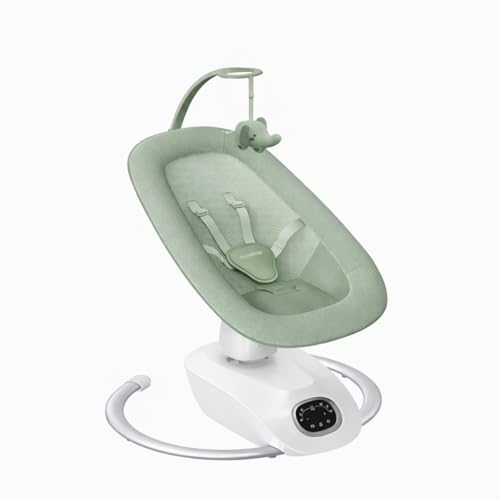
The Momcozy CocoSway 3D-Motion Electric Baby Swing is the most disruptive product in the baby swing category right now. At $145 — roughly one-third the price of the $349 UPPAbaby Mamaroo — the CocoSway delivers six 3D motion patterns, a 180° rotating seat, a touch screen control panel, and a remote control. Multiple direct-comparison reviews reach the same conclusion: 'skip the Mamaroo and get this.' Whether that's the right advice for your family depends on three specific factors we'll walk through honestly: brand-reliability risk, the realities of what 'multi-motion' actually means at this price point, and the long-term durability question that won't have a clear answer for another 12–24 months.
Momcozy is a relatively new direct-to-consumer baby gear brand that built its reputation through Amazon-first launches of breast pumps, swaddles, and white noise machines. The CocoSway is the brand's flagship swing product and represents an aggressive bet that parents will accept a less-established brand if the feature set is competitive enough. So far, parent reviews on Amazon and other major retailers have been overwhelmingly positive — typically 4.5+ stars across thousands of reviews — and the design quality, when you see one in person, is clearly above what you'd expect at the price.
The risk is durability. A baby swing's value calculation includes how reliably it works for the full 5–7 month useful life, and we don't yet have years of data on how the CocoSway holds up. The legacy brands (Fisher-Price, Graco, Munchkin) have decades of motor-reliability track record that newer brands like Momcozy haven't had time to accumulate. This review walks through what the CocoSway does right, where the legitimate concerns are, and the specific scenario where it's the smartest purchase in the entire category — and the scenario where you should pay the premium for an established brand instead.
Pros & Cons
Pros
- Closest direct competitor to the $349 Mamaroo at roughly ⅓ the price — patented 3D Swing Tech with 6 motion patterns
- 180° rotating seat for parent visibility while you work or eat
- Quiet operation on most modes, easy 10-minute assembly
- Touch screen panel and remote control feel premium for the price
- Genuinely good-looking — multiple reviewers say 'skip the Mamaroo and get this'
Cons
- Power cord is short and some reports of cord durability issues — outlet placement matters
- Some units develop a grinding or squeaking noise after a few months of use
- 25-minute auto-shutoff can interrupt naps just as baby fully drifts off
- Sounds don't loop — you have to manually restart them
- Newborn head support is minimal; parents report rolling burp cloths under smaller babies
Momcozy CocoSway 3D-Motion Electric Baby Swing
Prices may change · Free shipping with Prime
The Six Motion Patterns: What's Actually Different
The CocoSway's headline feature is its patented 3D Swing Tech, which delivers six distinct motion patterns: side-to-side, bounce, figure-8, M-shape, O-shape, and U-shape. The first two (side-to-side and bounce) are the most baby-friendly and what most parents end up using daily. The latter four (figure-8, M, O, U) are more aggressive multi-axis motions that are intended to mimic the unpredictable rhythm of a parent walking around with a baby on their shoulder.
In practice, parent reports cluster around a consistent pattern: most babies respond best to side-to-side or bounce, with figure-8 as an occasional 'witching hour' tool when nothing else is working. The M, O, and U patterns are more polarizing — some babies love the unpredictability and settle quickly, while others find them overstimulating and resist. This mirrors the same reality with the Mamaroo's five motions: motion variety is genuinely useful, but most babies have one or two preferred motions and the rest go unused.
The six-pattern advantage over the Mamaroo's five is more about marketing than functional difference. Both products give you motion variety, and both let you cycle through options to find what works for your specific baby. The CocoSway's M/O/U patterns aren't 'better' than the Mamaroo's Cruise/Wave — they're different, and either set will give a fussy baby enough variety to find something that works.
Where the CocoSway has a real edge: the touch screen lets you switch between motions instantly without going through a setup process. The remote control extends this further — you can change motion patterns from the couch, bed, or another room, similar to (but without the app integration of) the Mamaroo. This is a meaningful quality-of-life feature that most $150 swings don't offer, and it's part of why the CocoSway feels closer to a premium product than its price suggests.
The 180° Rotating Seat and Why It Matters for Working Parents
The CocoSway's 180° rotating seat is a feature the Mamaroo lacks, and it's genuinely useful for the work-from-home parent persona. The seat rotates a full half-circle, letting you change baby's orientation toward you (or away from you, toward a window or screen) without picking baby up and rotating the entire base. Unlike the Maxi-Cosi Cassia's 360° rotation, the CocoSway is limited to 180°, but that's still enough range to handle the most common use cases.
For a parent working from a home office or kitchen island, the rotation lets you keep baby visible during a Zoom call, then rotate them to face the calmer wall when nap time approaches. For families with toddlers in the house, the rotation lets you angle baby away from older siblings during their high-energy moments. For pet households, you can angle baby away from a dog's preferred sniffing approach.
The rotation mechanism is solid in person — there's a clear lock at the central position and at each 90° increment. We don't see consistent reports of it loosening or developing play over time, though again, the long-term durability question (12+ months of daily rotation) is genuinely unknown for this product.
The rotation also makes the CocoSway easier to position in any room. Most full-size swings need to be oriented one specific way for parent visibility, which can constrain where you place the swing. The CocoSway's rotation gives you placement flexibility — put it where it physically fits, then rotate the seat to face wherever you'll be.
The Brand-Reliability Question: Real Concerns and Real Mitigations
The single legitimate concern with the CocoSway is brand reliability. Momcozy is a Chinese DTC brand that's grown rapidly through Amazon-first launches in the last 5 years. They iterate quickly, which is great when you're considering a new product (the design quality is competitive with much more expensive alternatives) but introduces uncertainty about how a specific unit will hold up over 6–12 months of daily use.
The specific durability concerns we've seen in parent reviews: power cord length is short and some reports of cord durability issues; some units develop a grinding or squeaking noise after several months of use; sounds don't loop, requiring manual restart; and the 25-minute auto-shutoff can interrupt naps just as baby fully drifts off. None of these are deal-breakers individually, but they accumulate into a 'this is a younger product line' impression that the legacy brands (Munchkin, Fisher-Price, Ingenuity) don't have.
For reliability mitigation: buy from Amazon, not Momcozy direct or Temu. Amazon's return window (typically 30 days) and Amazon's broader buyer protection give you recourse if you receive a unit that develops problems early. Register your purchase with Momcozy at momcozy.com immediately after delivery — they have a 1-year warranty but warranty claims process faster when the product is registered. Use the swing on a surge-protected outlet to protect the motor electronics from voltage spikes (relevant for any motorized baby gear).
The risk-adjusted value proposition: at $145, even if the CocoSway only lasts 4 months instead of 6, you've still gotten 80%+ of the useful-life value at less than half the Mamaroo's price. The Mamaroo is more reliable but you're paying $200 more for that reliability. For most families, the math works in favor of the CocoSway.
Who Should Buy This
Buy the CocoSway if you want multi-motion soothing capability without paying $349 for the Mamaroo, if you're a tech-forward but budget-conscious shopper who prioritizes feature-per-dollar value, if your baby has shown signs of needing motion variety to stay calm (colicky, fussy, or just a baby who gets bored quickly with single-direction sway), if 180° rotation matters for your home setup or work-from-home situation, or if you're willing to accept a small durability risk for substantial savings.
Do not buy the CocoSway if absolute reliability is your top priority and you can't accept any uncertainty about long-term performance — pay for the Mamaroo or a Munchkin instead. Don't buy if you specifically want app or voice control — the CocoSway has remote control but no smart-home integration. Don't buy if you need a foldable swing for travel or storage — the CocoSway doesn't fold. Don't buy if a 25-minute auto-shutoff is a dealbreaker for your nap routine.
We consider the CocoSway the strongest pick in the under-$200 tier for parents who want multi-motion capability. It's also our top recommendation as a 'gateway' multi-motion swing — if you've never used a multi-motion swing before and aren't sure if your baby will respond to it, the CocoSway lets you find out at $145 instead of $349. If your baby loves it, you saved $200. If they don't, you can either resell (the secondhand market for the CocoSway is reasonable) or just be grateful you didn't spend an additional $200 on the Mamaroo only to find out the same thing.
Our Verdict
The strongest Mamaroo alternative on the market. The feature-to-price ratio is hard to beat and parent reviews skew very positive. Real risk is long-term durability — Momcozy is a newer DTC brand without a decade of motor reliability data behind it.
Momcozy CocoSway 3D-Motion Electric Baby Swing
$145
Prices may change · Free shipping with Prime
| Full Specifications | |
|---|---|
| Motion Type | Multi-directional 3D |
| Weight Limit | 20lbs |
| Motion Patterns | 6 |
| Speed Settings | 4 |
| Power Source | Plug-in |
| Bluetooth Audio | No |
| App Control | No |
| Voice Control | No |
| Rotating Seat | Yes |
| Recline Positions | 2 |
| JPMA Certified | No |
| Foldable | No |
| Dimensions | 28" x 26" x 30" |
| Product Weight | 12lbs |
Frequently Asked Questions
Is the Momcozy CocoSway really a Mamaroo dupe?
Is the Momcozy CocoSway durable enough to last 6 months?
Does the Momcozy CocoSway work for newborns?
Why is the Momcozy CocoSway so much cheaper than the UPPAbaby Mamaroo?
Related Buying Guides
Compare With Similar Baby Swings
Munchkin
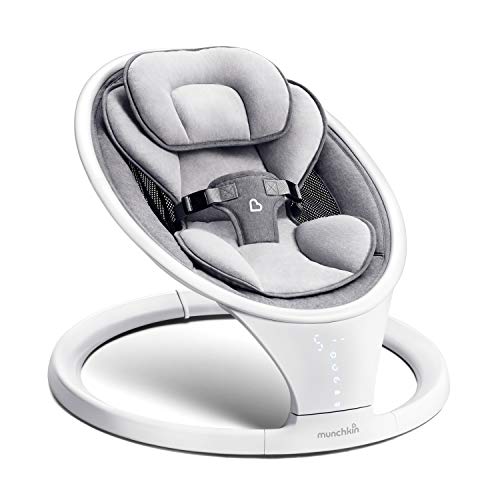
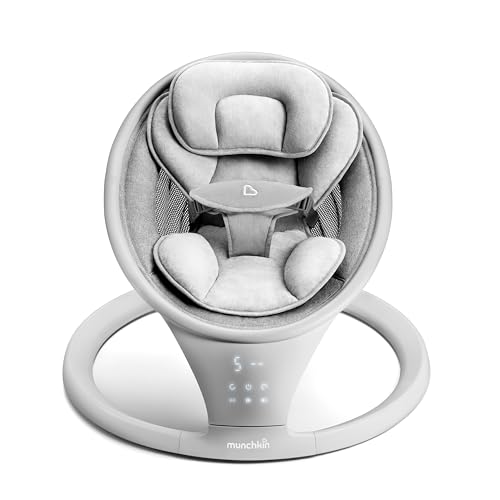
Electric Baby Swing with Vibration
Side-to-side + Vibration · 20 lbs · 1
$185
Head-to-Head Comparisons
Momcozy CocoSway 3D-Motion Electric Baby Swing
$145
Prices may change · Free shipping with Prime