At a Glance
Best For
Overview
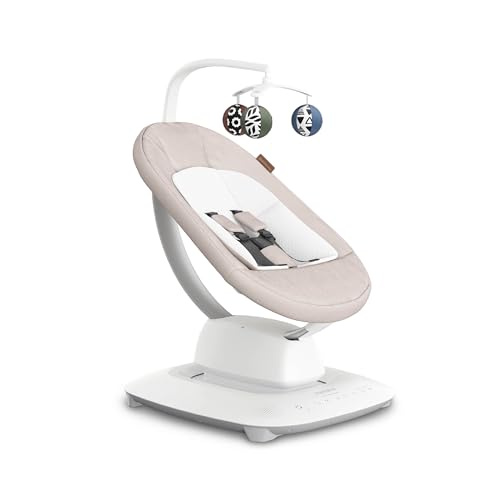
The UPPAbaby Mamaroo Smart Swing is the most recognizable baby swing on the planet — and for the last six months, it's been a different product than it was a year ago. UPPAbaby acquired 4moms in 2025 and consolidated the original MamaRoo into its In-Home Collection, rebranded it, and quietly walked the price up from $200 to $349. If you've heard friends rave about the Mamaroo or seen one in a hospital postpartum unit, the swing they're talking about and the swing you're considering buying today are nearly identical hardware in a new wrapper, with one critical asterisk we'll get to in the safety section.
What hasn't changed is what makes this swing the gold standard. Five distinct motion patterns — Cruise, Bounce, Sway, Rock, and Wave — try to mimic the way real parents actually rock babies, instead of the single mechanical sweep most swings rely on. Layer that with five speed settings, four soothing sounds, MotionSync (a pattern recorder that lets you teach the swing your specific rocking rhythm via the UPPAbaby app), and integration with both Amazon Alexa and Google Home, and you have something closer to a smart appliance than a piece of nursery furniture.
The Mamaroo isn't for every baby and it isn't for every budget. Roughly 1 in 4 newborns just don't take to multi-motion swings — they prefer simple side-to-side sway, the kind of motion the $170 Munchkin Bluetooth delivers all day for half the price. There's no way to predict in advance whether your baby will love it or be the one who screams the moment you turn it on. At $349, that's a meaningful gamble. This review walks through what the Mamaroo does brilliantly, where it falls short, and the specific situations where the premium is genuinely worth it.
Pros & Cons
Pros
- Five distinct parent-inspired motions (Cruise, Bounce, Sway, Rock, Wave) — if baby gets bored of one, you have four backups
- MotionSync lets you record your own rocking pattern in the UPPAbaby app and the swing replays it
- App + Alexa + Google Home control — adjust speed and motion without walking over and disturbing baby
- Used in 600+ NICUs and maternity wards in North America (huge confidence builder for first-time parents)
- JPMA and GREENGUARD Gold certified, with a stall feature that stops motion if obstructed
Cons
- Polarizing — roughly 1 in 4 babies just don't take to multi-motion swings, and there's no way to predict which baby is yours
- Premium price for a product with a 5–7 month useful life
- Music quality is reportedly tinny on certain settings
- Toy mobile balls don't auto-rotate (some competitors do)
- Price hike from old 4moms ($200) to new UPPAbaby ($299–$349) caught some return buyers off guard
UPPAbaby Mamaroo Smart Swing
Prices may change · Free shipping with Prime
The Five Motions: What's Actually Different
Most baby swings have one motion. They go side-to-side, or they go front-to-back, and they do it in a single fixed arc with adjustable speed. The Mamaroo's defining feature is that it has five distinct motion patterns, each engineered to mimic how real human caregivers move babies in the real world.
Cruise mimics the rolling, rocking motion of a car ride — think long, slow, gentle arcs. It's the motion most babies fall asleep to in the back seat on the way home from daycare. Bounce is the classic gentle up-and-down dip a parent does standing in the kitchen with a baby on their shoulder. Sway is exactly what it sounds like — a side-to-side arc similar to what most single-motion swings do, but with the option to vary intensity. Rock is faster and more pronounced front-to-back, the way a parent rocks in a glider chair. Wave is a softer, more rolling motion across multiple axes — the most distinctive of the five, and the one parents most often report as the magic mode for fussy babies.
Why does motion variety matter? Because babies are individuals, and what worked yesterday might not work today. Parents of colicky babies in particular report cycling through all five motions during a single witching-hour session — Cruise to start, switch to Sway when baby gets restless, drop to Wave when nothing else works. With a single-motion swing, when baby decides today's not the day for side-to-side sway, you have nothing left in the toolbox. With the Mamaroo, you have four backups.
This is also the source of the Mamaroo's biggest weakness. About 25% of babies — based on aggregated parent reports across major review platforms — actively dislike multi-motion swings. They want the simple, predictable, single-axis sway of a basic swing, and the more complex Mamaroo motions stress them out. There is no way to predict which group your baby falls into until you actually put them in one. Parents of multi-kid households often report that one child loved the Mamaroo and a sibling refused to sit in it. Go in with that expectation.
MotionSync, App Control, and Voice Integration
Beyond the five preset motions, the Mamaroo offers something genuinely novel for the category: MotionSync. Through the UPPAbaby app on your phone, you can record your own rocking pattern — literally hold the phone while you rock your baby in a way that works for your particular kid — and the swing replays that exact pattern. We've seen plenty of 'app-connected' baby gear over the years that's mostly marketing veneer; MotionSync is the rare smart-home feature that does something the dumb version of the product genuinely can't.
The app itself runs on iOS and Android, connects to the swing via Bluetooth, and gives you remote control over motion type, speed, and sound from anywhere in the house. The practical value of this is enormous in the first few months: when you've finally gotten baby to a calm, drowsy state in the swing, the absolute last thing you want to do is walk over and physically press a button that might startle them awake. The app lets you adjust speed or change motion patterns from the couch, the bathroom, or your home office without making a sound.
Voice integration with Amazon Alexa and Google Home extends this further. 'Alexa, set Mamaroo to Sway, speed two' is a meaningful quality-of-life upgrade when you're holding a bottle in one hand and a burp cloth in the other. The setup is straightforward — you connect the swing through the UPPAbaby app, then enable the corresponding skill or action on your voice assistant of choice.
Is all of this necessary? No. Plenty of babies are perfectly soothed by a $75 Fisher-Price On-the-Go that has none of these features. But for tech-forward parents and households where the swing will be used multiple hours a day for several months, the app and voice control compound into real time savings. If you'd never use the app, you're paying a meaningful premium for features that won't earn their keep.
Safety, Recall Context, and Hospital Use
This is the most important section in this review and the part most product reviews skip. The current UPPAbaby Mamaroo Smart Swing is JPMA certified, GREENGUARD Gold certified, and used in 600+ NICUs and maternity wards across North America. It includes a five-point harness, a stall feature that automatically stops motion if obstructed, and a reclined seat with a 25°–45° range. UPPAbaby ships a newborn insert in the box, which the older 4moms model required as a separate purchase.
Here is the asterisk: the older 4moms MamaRoo (versions 1.0 through 4.0, model numbers 4M-005, 1026, 1037) and the related RockaRoo (model 4M-012) are subject to an active CPSC recall. The recall covers older units where the restraint straps can dangle below the seat when the swing is not in use, posing a strangulation risk to crawling infants who pull themselves up to the seat. UPPAbaby has provided a free repair kit available at uppababy.com/mamaroo-4moms-recall.
The current UPPAbaby Mamaroo Smart Swing — the one we're reviewing here, sold under the UPPAbaby brand on Amazon and at uppababy.com — is NOT part of this recall. It's a different product line under different ownership with redesigned restraint straps. If you're buying a Mamaroo on the secondhand market (Facebook Marketplace, Craigslist, friends-of-friends), you must verify the model number before use and request the repair kit if it's an older 4moms model.
On the broader swing safety conversation: the AAP and CPSC are explicit that no inclined seat — including the Mamaroo — should ever be used as a sleep surface. If your baby falls asleep in the swing, transfer them to a flat firm surface (crib or bassinet) immediately. Always use the harness, even for a 30-second adjustment. Never leave baby unattended. The 600+ NICU placements are a confidence builder, but the swing is an awake-time soothing product, full stop.
Who Should Buy This (And Who Absolutely Shouldn't)
Buy the Mamaroo if you're a tech-forward parent who'll actually use the app and voice control, if your household will use the swing daily for multiple hours during the 0–6 month window, if you have budget flexibility and want the gold-standard option, or if you're a multi-kid family where the resale value (which is genuinely strong on the secondhand market) will recoup part of the cost. The Mamaroo also has a real edge for colicky or fussy babies whose parents need motion variety to find what works on any given day — the five patterns are an actual functional advantage, not just spec-sheet fluff.
Do not buy the Mamaroo if you suspect your baby is going to be a single-motion-sway kid (most don't reveal this until you put them in one, but if your baby already shows strong preference for predictable, simple motion in your arms, that's a hint), if your budget is tight enough that $349 is a stretch, if you live in a small space and need a foldable swing — the Mamaroo doesn't fold, and at 19 lbs it's not portable, or if you primarily want a swing for travel or grandparents' houses. The Munchkin Bluetooth ($170), Maxi-Cosi Cassia ($200), or — for direct multi-motion competition at half the price — the Momcozy CocoSway ($145) all make more sense in those situations.
The most honest framing: the Mamaroo is best-in-class when it works, and an expensive lesson when it doesn't. The 1-in-4 reject rate is real. If you can stomach the financial risk, the upside is the best soothing technology on the market. If you can't, the $145 Momcozy CocoSway delivers most of the multi-motion experience for a third of the price, and you can graduate to a Mamaroo later if you decide you actually want the app and voice control.
Our Verdict
The best baby swing on the market if your baby tolerates multi-motion — and the worst $349 you'll spend if they don't. The hospital pedigree, app control, and motion variety are unmatched, but go in eyes-open about the 1-in-4 reject rate.
UPPAbaby Mamaroo Smart Swing
$349
Prices may change · Free shipping with Prime
| Full Specifications | |
|---|---|
| Motion Type | Multi-directional 3D |
| Weight Limit | 25lbs |
| Motion Patterns | 5 |
| Speed Settings | 5 |
| Power Source | Plug-in |
| Bluetooth Audio | Yes |
| App Control | Yes |
| Voice Control | Yes |
| Rotating Seat | No |
| Recline Positions | 2 |
| JPMA Certified | Yes |
| Foldable | No |
| Dimensions | 32.5" x 24" x 26" |
| Product Weight | 19lbs |
Frequently Asked Questions
Is the UPPAbaby Mamaroo the same as the 4moms MamaRoo?
Is the Mamaroo recalled? Is it safe to buy in 2026?
Can babies sleep in the UPPAbaby Mamaroo?
How does the UPPAbaby Mamaroo compare to the Momcozy CocoSway?
Related Buying Guides
Head-to-Head Comparisons
UPPAbaby Mamaroo Smart Swing
$349
Prices may change · Free shipping with Prime